

Why emulsifiers?
Why do we need them?
As we all know Chocolate is a suspension of cocoa and sugar particle coated with fat, with extra fat as the medium.(Read previous articles The importance of Micron size and The importance of Viscosity in Chocolates). But how easy is it to coat the sugar particles with fat? Or how hard is it? Are the sugar particles , fat loving? Or do they need some help with the coating? That’s where emulsifiers come in the picture.
Before we deep dive in the role of emulsifiers in chocolate manufacturing, let us discuss a bit about what are emulsifiers first.
What are emulsifiers?
Emulsification is mixing of two unmixable substances. It makes sense then, there should be some thing extra when mixing these unmixable substances, which would help them mix. That something extra are Emulsifiers.
To mix two or more immiscible substances, the particles of the individual must be coated with the emuslifier. The emuslifier must have chemical properties which attracts both immiscible substances.
In more common day to day objects, examples of emulsion would be cream(like mayonnaise) which is a oil in water emulsion, and milk which is a water in oil emulsion.
Chocolate is not very good with water which we would like to discuss in a future blog. So there must be something else which acts as a boundary between the sugar particles and fat in chocolate. To be more specific, a surface-active agent is required. Why? Do remember, that the cocoa and the sugar particles must be coated with Fat. Now this emulsifier or the surface active agent acts as a boundary between the individual particles and the fat, in the fat as a medium, ensuring more and more particles are coated with fat.
The more particles that are coated with fat, the more the texture of chocolate is smooth, less grainy and there are more chances of achieving the required viscosity range.
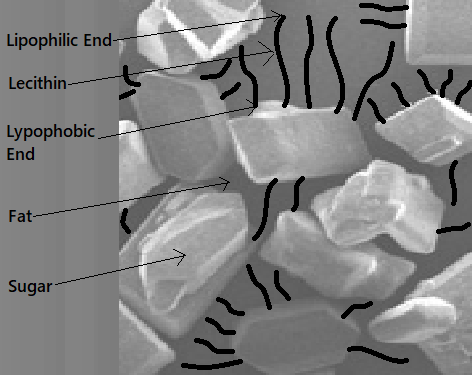
In the case of chocolate, this emulsifier is generally fat attracting(lipophilic) on one end due to which it attaches itself to the fat particles and the other end is fat repelling(lypophobic), which goes to attach itself to the also fat repelling sugar particles. And voila! You have successfully created an emulsification.
Is there something as too much or too less emulsifier?
Well it would depend on the actual chocolate end product you are looking to manufacture and the type of emulsifier you are using.
Some emulsifiers have strong affiliation with the sugar particles thereby creating a strong bond, which would inherently mean that the yield viscosity has become very high.(if you have not read our article on chocolate viscosity read it here). If the emulsifier has strong affiliation with the fat particles the yield viscosity would be low. By changing the type of emulsifier and the percentage content, various products can be achieved.
At higher levels of lecithin, the boundary which had formed between the sugar particles and the fat, facilitating the flowability or decreasing the viscosity, again creates a secondary boundary layer, which in fact hinders the flowability and again increases the viscosity.
A good example of using too little emulsifier is when in your chocolate paste spread, the fat separates, even in stable conditions. Similarly an example of using too much emulsifier is when the chocolate viscosity increases(due to secondary layer formation) so much that it becomes difficult to process further.
What are some types of Emulsifiers?
Lecithin is the most common type of emulsifier. Lecithin in very small amounts is also present in the cocoa beans. But a substantially higher content of lecithin is required (compared to its percentage in cocoa beans) for it to be successfully used as a surface active agent.
The most common sources of lecithin are as below: –
- Soya Lecithin
- Eggs(yolks)
- Sunflower lecithin
- Castor oil lecithin and others.
The major component which makes lecithin an emulsifier is a phospholipid, among others.
In the confectionery industry, Soya lecithin is more commercially used, due to its lesser cost and its strong affiliation with the sugar particles. In more organic and bean to bar chocolate setups, instead of soya lecithin , sunflower lecithin is used.
Ammonium Phospatide- AMP
A special surface active agent developed by Cadbury is Ammonium Phospatide(AMP) manufactured from rapeseed oil also called YN.
More established chocolate factories prefer to use YN or AMP as it is called, due to its advantages over standard soy derived lecithin. At higher levels of lecithin as discussed earlier, the viscosity increase in chocolate is somewhat negated by using YN/AMP. More recent innovations by big names claim that their AMP is made up from sunflower and glycerine, which stops its dependence on soy or castor, creating an endless supply.
PGPR
The most common other emulsifier which is used in confectionery industry is PGPR(Polyglycerol polricinoleate) or its commercial name Admul, Myvatex, Finamul etc. To be used in the baking industry by polycondensation of Castor Oil, it has very less effect on the plastic viscosity but a large effect on the yield viscosity. It has also the advantage over lecithin that, in comparison to lecithin a change in yield viscosity can be achieved at a lower percentage.
Other emulsifiers
There are other emulsifiers also available in market such as sorbitan esters and others , but combining cost and efficiency, none give the desired results as much as Lecithin or PGPR.
When should be emulsifiers added in the chocolate manufacturing process?
As a rule, the majority of lecithin should be added towards the end of the process, or when most of the unwanted water has evaporated from the mixture.
As one end of the lecithin is fat repelling (lypophobic) or can be said water attracting, instead of binding on to the sugar particles, it would attach itself to the water molecules and it would be difficult to remove the water molecules out from the chocolate then. It would also effect the yield viscosity of the chocolate and the time required to get the desired texture would greatly increase and so will the costs associated.
We hope that you have liked this post and it has helped you in your emulsifier requirements.
 rudvik engineers